Article
I Thought I Was Building FindTribe for Festivals. Then Everything Changed.
FindTribe began as a way to navigate festivals. An earthquake in Colombia revealed a much larger mission: mapping changing worlds and getting messages through when infrastructure fails.
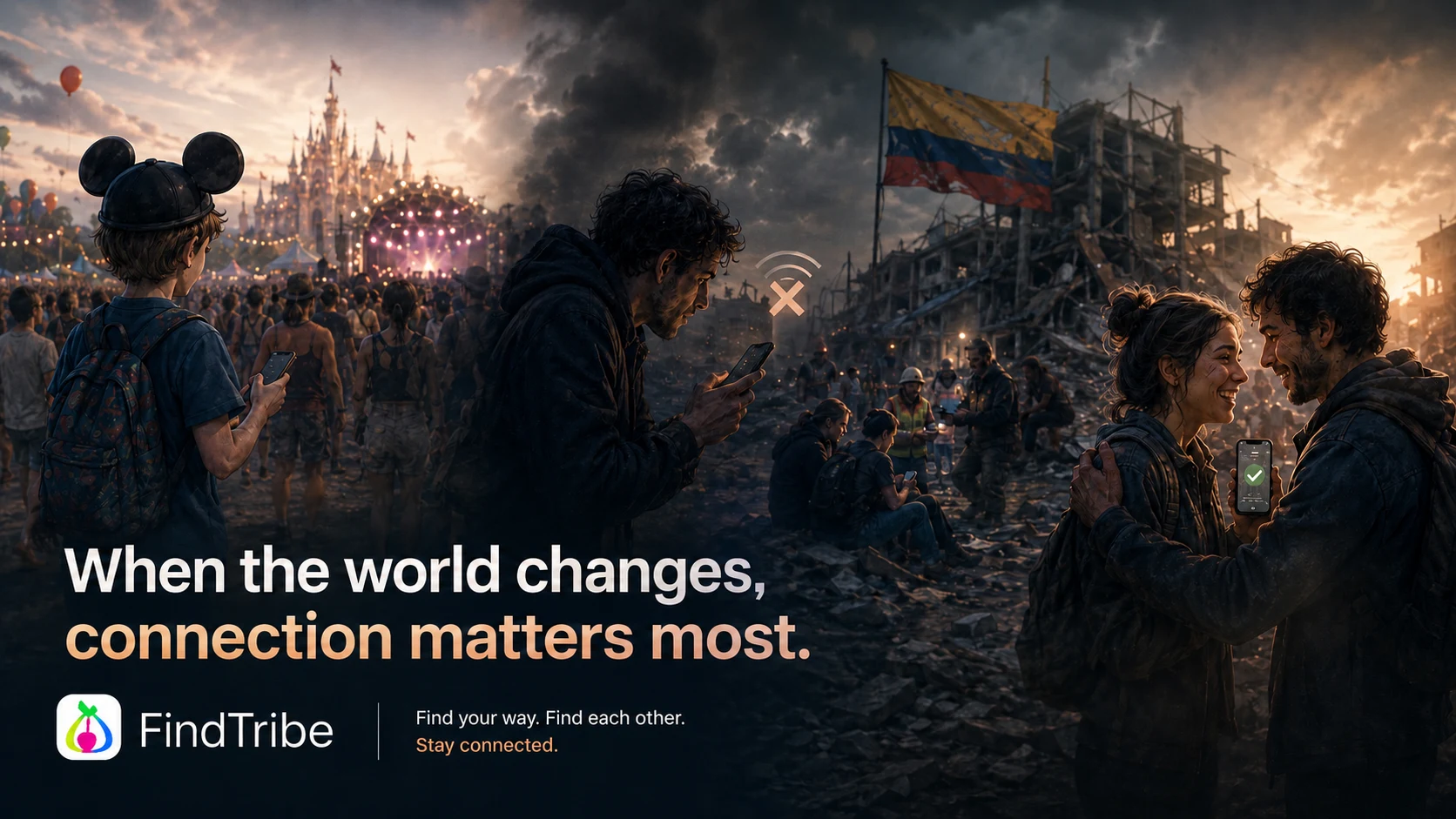
Just two weeks ago, if you had asked me why I built FindTribe, I probably would have started with a story about getting lost.
The first time was at Disney when I was a kid.
Years later, it happened again at a music festival.
Apparently, this is a recurring theme in my life.
At some point, I had to accept that maybe the common denominator was me. I have a terrible sense of direction.
Fortunately, I’m far from alone in depending on technology to figure out where I am. Google Maps alone has more than 2 billion users every month. As a society, we’ve become incredibly comfortable outsourcing our sense of direction to the little blue dot on our phones.
We expect to pull out a device, see exactly where we are, understand what is around us, and get directions almost anywhere.
And then we walk into a music festival.
When the modern world suddenly feels very old
Tens of thousands of people arrive in the same place. Cellular networks become overwhelmed. Friends disappear into the crowd. Messages stop going through.
And strangely, our navigation experience goes backward in time.
Remember unfolding a giant paper map, turning it around a few times, trying to orient yourself, and then attempting to remember the route?
That is still surprisingly close to how we navigate many large events today.
The paper map has been replaced by a static image on our phone, or maybe a giant billboard somewhere on the festival grounds, but the experience really hasn’t changed that much.
You still need to figure out where you are.
You still need to figure out where you are going.
And then you have to somehow remember the route while thousands of people, lights, stages, music, food stands, security barriers, and everything else around you compete for your attention.
It always seemed strange to me.
We are standing inside what is essentially a temporary city, sometimes with tens of thousands of people, using a navigation experience that hasn’t really caught up with the world around it.
That was the original idea behind FindTribe.
Mapping the places that disappear
Google Maps is extraordinary at mapping the permanent world.
Streets. Restaurants. Airports. Hotels. Buildings. Businesses.
Places that will probably still be there tomorrow.
FindTribe is built for the places that won’t.
A music festival can become a small city for three days. It has its own roads, stages, medical tents, bathrooms, entrances, exits, VIP areas, meeting points, vendors, and tens of thousands of temporary residents.
Then, almost overnight, the entire city disappears.
Traditional mapping platforms simply weren’t designed around environments like that.
I wanted to give those places their own living maps.
A map that understood the event itself.
A map that could help you find a stage instead of a street address.
A map that could help you find the people you came with.
A map that could change as the environment changed.
And because cellular networks at large events are often unreliable precisely when the crowds are largest, FindTribe also needed another quality that gradually became central to what we were building:
It needed to keep working when the network didn’t.
For a long time, I thought that was the problem.
Then the earthquake hit Colombia.
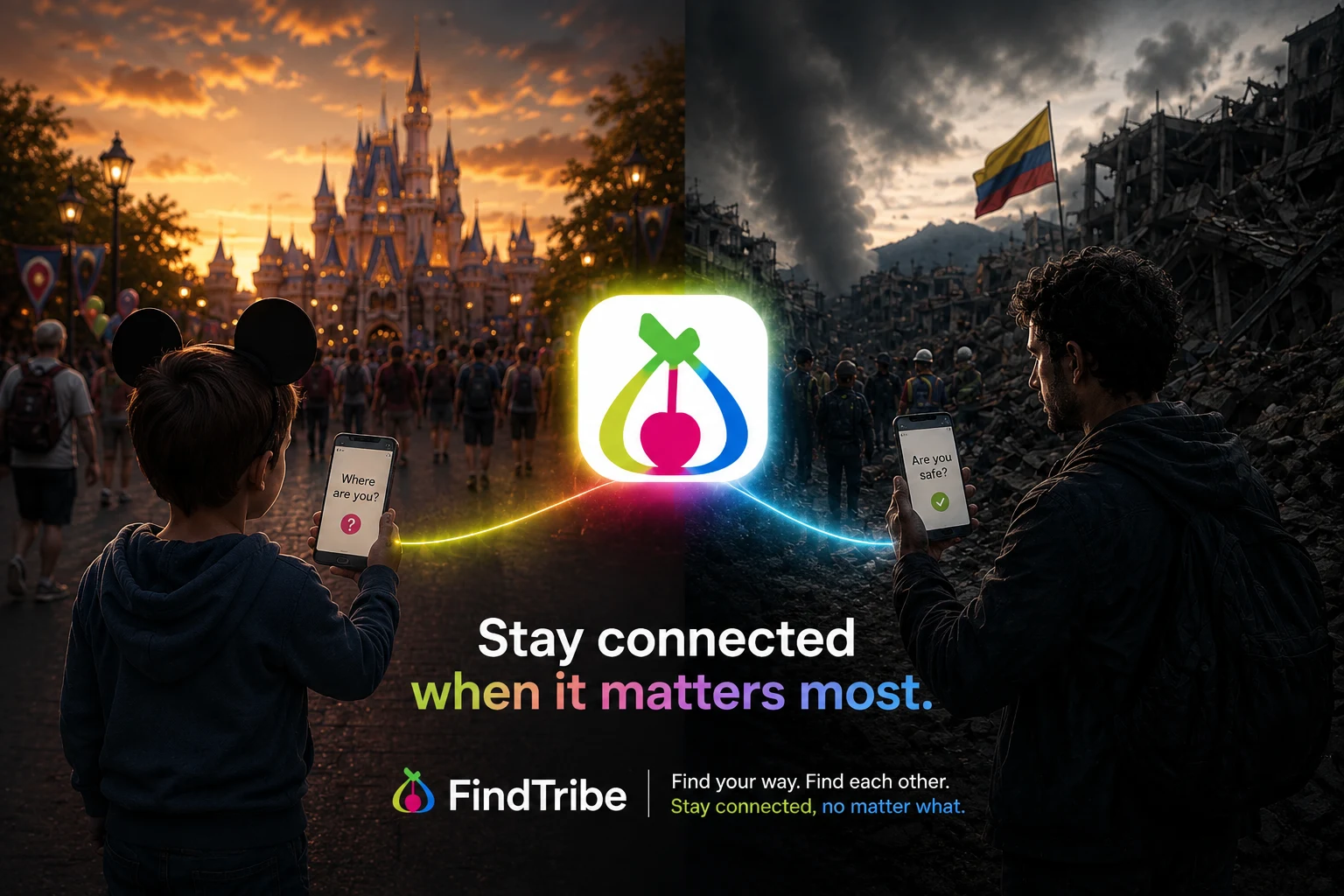
The moment FindTribe changed for me
I have family in Colombia.
When the earthquake happened, communications went down, and for hours I couldn’t reach people I love.
I couldn’t ask whether they were safe.
I couldn’t know whether they were injured.
I couldn’t even know whether they had received my messages.
There was nothing to do but wait.
And while I was waiting, I started thinking about FindTribe very differently.
Because suddenly I realized something that seems obvious to me now:
Temporary places aren’t always festivals.
Sometimes the temporary world is created because something has gone wrong.
An earthquake can change the map of a neighborhood overnight.
A road that was perfectly usable yesterday can suddenly become inaccessible.
A shelter can appear in a school or community center.
A medical station can be established in a parking lot.
A supply distribution point, evacuation route, rescue area, or safe gathering place can suddenly become one of the most important locations in a city.
The physical world changes faster than the traditional digital map can reflect it.
And sometimes, while the map is changing, the communication infrastructure disappears with it.
That changed the way I saw the problem.
What if the map could change with the world?
FindTribe now allows people to create and share maps for changing environments, not just festivals.
The same underlying idea applies.
Create a map around what matters right now.
Add the locations people actually need.
Share it with the people who need to see it.
Update it as conditions change.
At a festival, that might mean stages, entrances, medical tents, bathrooms, or meeting locations.
During an emergency, it could mean shelters, blocked roads, medical assistance, supply points, evacuation areas, or places where people have gathered safely.
The environment is different.
The underlying problem is remarkably similar.
People need to understand where they are, what is around them, where other people are, and how to reach them.
But a map is only useful if people can access it.
And communication is only useful if the message can actually get through.
That leads to the other half of what FindTribe is becoming.
The network shouldn’t matter
Most apps are built around an assumption we barely notice anymore:
The internet will be there.
Normally, that assumption works remarkably well.
Until it doesn’t.
That is why FindTribe is being designed differently.
Today, FindTribe can communicate through multiple paths.
When internet connectivity is available, it can use the internet.
When traditional connectivity becomes unavailable, nearby devices can communicate directly through Bluetooth.
Bluetooth mesh allows information to move between devices, so one nearby device can help relay information toward another without requiring normal internet infrastructure.
For communication over much greater distances, FindTribe is also expanding into long-range LoRa connectivity, where dedicated devices and repeaters can move information far beyond Bluetooth range.
And as satellite connectivity becomes increasingly accessible to phones and consumer devices, satellite can eventually become another path available to the system.
But the most important part isn't Bluetooth.
It isn't LoRa.
It isn't satellite.
And it isn't the internet.
The important part is that the message gets there.
Press send. Let FindTribe figure out the rest.
I don't think someone trying to reach a friend, a child, a parent, or another person they care about should have to think about networking technology.
They shouldn't need to know whether cellular service is working.
They shouldn't need to understand Bluetooth mesh.
They shouldn't need to know what LoRa is.
They shouldn't need to choose between Wi-Fi, satellite, a repeater, or some communication technology that hasn't even been invented yet.
They should just be able to press send.
FindTribe's job should be to figure out how to get the message there.
If one path is available, use it.
If that path fails, try another.
If several paths exist, use the ones that make sense.
Instead of treating a single network as the connection, FindTribe can treat every available network as a potential path.
The goal is simple: remove as many single points of failure as possible.
That's the reliability play behind what we're building.
From finding a stage to finding the people who matter
I never expected FindTribe to evolve in this direction.
It started because I kept getting lost.
I wanted a better way to navigate festivals and a better way to find the people I came with.
I still want that.
I still want someone standing in the middle of a massive festival to open FindTribe, see exactly where they are, find the stage they want, locate their friends, and enjoy the event instead of staring at a static map wondering which direction they're facing.
But now I understand that the underlying problem is much bigger.
Sometimes we get lost because we walked away from our friends in a crowd.
Sometimes we get lost because the world around us suddenly changed.
And sometimes the people we care about feel impossibly far away simply because the infrastructure connecting us stopped working.
FindTribe is becoming a platform for those moments.
A platform for mapping temporary worlds.
For understanding what is around you when the environment changes.
For finding the people who matter.
And for staying connected without depending entirely on any single network.
What started because I kept getting lost has evolved into something I never expected.
I still want to make sure nobody gets lost at a festival.
I just realized there are much bigger ways to get lost.
And I don't think losing the internet should mean losing the ability to find your way, understand what's happening around you, or reach the people you love.
That's what I'm building FindTribe to solve.